
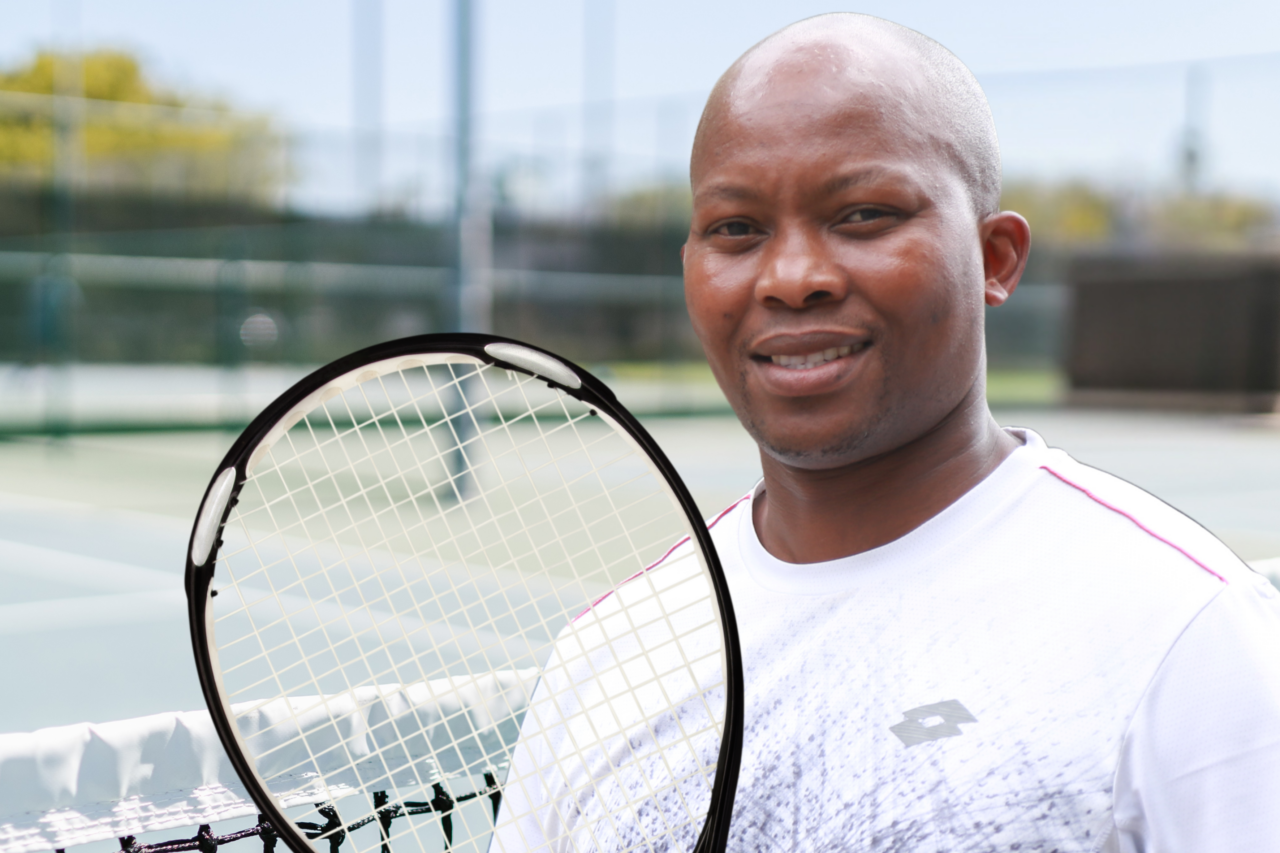
Fort Hare tennis instructor Thabo Gwegwana knows more than most about the highs and lows of the game.
A mere two years after joining the university in 2012, his charges placed second in Section C of the University Sports South Africa tournament to win promotion to the second tier.
However, it would be another 10 years until the historic Eastern Cape institution featured again.
The 40-year-old, who holds a national diploma in sport and fitness management, has endured a rollercoaster of emotions since the sport hit the doldrums.
But his heart was pumping 50 shades of blue when the Fort Hare team made their long-awaited return to the USSAs in December with wind in their sails.
Despite arriving in Pretoria with largely untested players, they proceeded to deliver the goods to guarantee their place in the 2025 tournament.
“We had a whole group of inexperienced players and we threw them in at the deep end,” coach Gwegwana admitted.

Fort Hare tennis instructor Thabo Gwegwana, a registered Tennis South Africa coach and umpire, can’t wait to build on the university’s resurgence this year. Photo: Full Stop Communications
“I thank the staff and administrators for believing in us. Now I want to go back to the USSAs stronger.”
To this end, he will register his players with Tennis South Africa (TSA) and enter Fort Hare in the East London league to get them on a level court with the top tennis-playing universities.
Though the profile of the sport has fluctuated over the years, Gwegwana’s passion has never waned.
Interestingly, he initially believed cricket would shape his future. As very little tennis was being played in his hometown of Ngcobo, he harboured ambitions of becoming the next Makhaya Ntini.
But unable to access professional coaching at the time due to funding constraints, he ran out of time to make his mark in the game. The silver lining was that he “found tennis” when he started his studies at WSU.
The following year he started dabbling in coaching as he was determined that the students should take full advantage of the facilities on offer at the varsity.
Gwegwana knew what it was to be held back by a lack of resources and his commitment to improving the players did not go unnoticed.
After his studies, he worked at Wheelchair Tennis South Africa (WTSA) for four years. There he mentored players of the calibre of Mzwanele Tintsi and the late Noma-Africa Gxumisa, five and four-time ITF Super Series competitors, respectively.
Having experienced success in the persons-with-disabilities tennis arena, he started working as a private coach for some of South Africa’s rising stars. They included Siphosothando Montsi, Khololwam Montsi and Kwanda Mbalekwa, all of whom were later picked up by colleges in the United States.
On graduating Stateside, Mbalekwa sent his former coach a heartwarming message:
“I want to say thank you because you played a big role in me being able to get to this stage.
“You were more than a coach to me, you [were] like an older brother and I want to thank you for everything. This is not only my achievement but yours too.”
Gwegwana has also established himself as a top-class official.
While working for WTSA in 2008, he was among a group of people selected to train as umpires and line judges. He was soon travelling far and wide to officiate matches and was tasked by TSA to recruit more officials in the Eastern Cape.
In 2023, his umpiring took him to the SA Open, TSA Super 8 and nationals. In the latter he was named chair umpire for the final.
Last year, TSA mandated him to do live scoring from the nationals for a television audience.
“I enjoy those challenges,” he said.
With Fort Hare tennis now well and truly back on track, the ball is now in his court to make it stick.